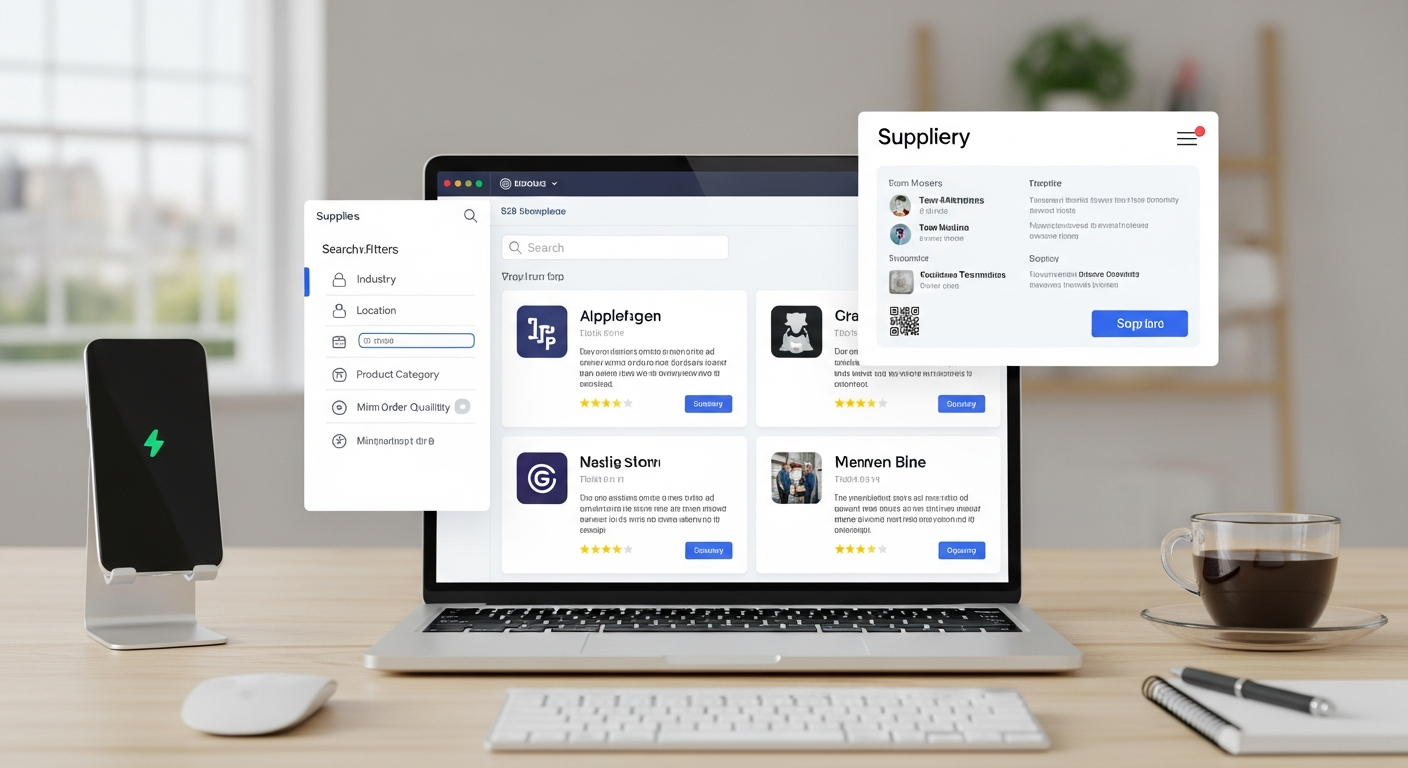
Customer acquisition for a contract manufacturer starts before the sales call. It starts when a buyer can understand, from a search result or profile page, what the factory can produce, which projects it should avoid and what evidence it can share.
Many capable suppliers stay invisible because they describe themselves as generally flexible. Buyers do not buy flexibility in the abstract; they buy a controlled route from need, sample and quotation to production approval.
The practical goal is not more traffic at any cost. It is a cleaner first conversation: fewer vague price requests, more briefs with product scope, volume, packaging, target market and documentation expectations.

Start with the buying situation, not the factory story
A manufacturer may want to talk about machines, years of experience and broad sector coverage. A buyer first wants to know whether the supplier fits this specific project. That means the content should name project types, line limits, sample rules and decision gates.
A strong acquisition page therefore works like a triage note. It tells a food brand, textile buyer, supplement startup or industrial purchaser which information is needed before the supplier can judge fit.
- Name the product families the supplier can quote with confidence.
- Separate prototype, pilot, recurring batch and urgent overflow work.
- State which inputs are needed before price discussion.
- Use sector language only where the supplier has real operating proof.
Turn visibility into qualification
Visibility without qualification creates inbox volume, not growth. If every page invites any buyer to ask for any product, the sales team spends time sorting weak leads. Clear acquisition content filters the market before the first message.
Qualification does not need to feel cold. It can be helpful: explain what a buyer should prepare, why the information matters and what the manufacturer can do after receiving it.
- Ask for volume, target launch date and packaging assumption.
- Explain when technical review is required before a quote.
- Use examples of acceptable briefs rather than generic contact prompts.
- Route low-fit projects to educational pages or service boundaries.
Proof beats promotional language
A page that says quality, fast delivery and best price gives the buyer almost nothing to verify. A page that names inspection records, certificate scope, response time, sample approval and change-control rules gives the buyer something to compare.
This is where customer acquisition and quality management meet. The more concrete the proof, the easier it is for a serious buyer to send a better RFQ.
- Mention certificate scope rather than certificate names alone.
- Describe how sample approval turns into production release.
- Show how changes are recorded after quotation.
- Keep unsupported claims out of the profile.
Build a repeatable first-response system
The manufacturer should not improvise every reply. A reusable intake note, a missing-information message and a short quote-readiness checklist keep the first response fast without making careless promises.
Over time, the questions that appear in real inquiries should feed back into the profile and service pages. Acquisition content becomes stronger when it learns from lost, won and declined RFQs.
- Track which service pages generate qualified inquiries.
- Record why RFQs are accepted, paused or declined.
- Add recurring buyer questions to the profile.
- Review lead quality monthly, not only traffic volume.
TR2B workflow for customer acquisition
On TR2B, the acquisition workflow should move from category fit to service listing, then from service listing to a structured buyer message. The supplier profile should not simply say that the company is available; it should make the next buying step obvious.
Use the platform to publish narrow service pages, connect them to a complete company profile and keep first-message rules visible. The best profile makes a serious buyer feel that the supplier is ready for a professional conversation.
TR2B overview | TR2B contract manufacturing category | TR2B supplier plans
Customer acquisition quality checklist
- Can a buyer identify the exact production scope in the first screen?
- Does the page explain what information is needed before quoting?
- Are proof points tied to records, certificates, samples or process controls?
- Does the profile reduce weak inquiries instead of inviting every possible project?
- Is there a standard first-response path for missing data?
Conclusion
Contract manufacturers find better customers when their digital presence works as a filter and a proof file at the same time. The writing should make real capability easier to find, easier to verify and easier to brief.
When Fason Zon education and TR2B profile fields reinforce each other, acquisition becomes less dependent on chance conversations and more dependent on disciplined supplier information.
Editorial quality checklist for Customer Acquisition for Contract Manufacturers
How Contract Manufacturers Find Customers EN guide should be used as a working decision file, not only as a reading page. The practical check is whether a buyer can leave the article with a clear scope, required evidence, supplier questions, risk owner and next action for Customer Acquisition for Contract Manufacturers.
For stronger SEO and buyer usefulness, this page now connects the topic to proof, implementation and related sourcing paths. That reduces thin-content risk and helps the reader move from general research to a verifiable supplier or operating decision.
- Define the decision: write product or service scope, target market, expected volume, approval owner and the date of the next review.
- Ask for current evidence: request documents that match this exact product, service, batch, process or customer scenario.
- Compare complete answers: score response quality, missing data, correction speed and commercial assumptions before comparing price.
- Keep the first order controlled: connect sample approval, release criteria, logistics, payment terms and corrective action in one note.
| Review area | Quality question |
|---|---|
| Scope | Product, market, volume, owner and release rule are written before supplier comparison. |
| Evidence | Specification, sample, quality record, certificate, label or service proof is checked for date and relevance. |
| Decision | The buyer records what can be approved now, what is blocked and who owns the next correction. |
FAQ for this article
What should be checked first for Customer Acquisition for Contract Manufacturers?
Start with the decision file: scope, evidence, acceptance criteria, delivery assumptions and the person who can approve or stop the next step.
How does this article support supplier or partner selection?
It turns the topic into a checklist of records, questions and comparison rules, so the reader can separate a strong answer from a generic sales reply.
When should the reader move to a related guide?
Move to a related guide when the next risk is outside the current page, such as supplier discovery, contract manufacturing, food safety, logistics or company verification.
Useful cross-site next reads
Guides That Strengthen Your Supplier Profile
Related checks for How Contract Manufacturers Find Customers: review these pages before supplier approval or production release.
- Supplier Profile for Contract Manufacturing Jobs
- Turning Unused Production Capacity into B2B Demand
- TR2B Benefits for Suppliers: Finding New Customers and Building B2B Demand
- Trusted Supplier Profile on B2B Platforms
- Contract Manufacturing Quote Template: Scope, MOQ and Lead Time
- Online Contract Manufacturing Platforms: RFQ and Supplier Search Guide
- Choosing the Right Contract Manufacturing Partner
- What is Contract Manufacturing? Complete Guide
Sources and Further Reading
Source check for How Contract Manufacturers Find Customers: official standards, regulator pages and sector references are listed below. Validate final legal, medical, food or export decisions against the current primary text.