The dietary supplement sector is growing rapidly worldwide as health awareness increases. If you want to create your own dietary supplement brand, contract manufacturing stands out as the most practical and cost-effective approach. In this guide, we examine all stages of dietary supplement contract manufacturing in detail.
What is Dietary Supplement Contract Manufacturing?
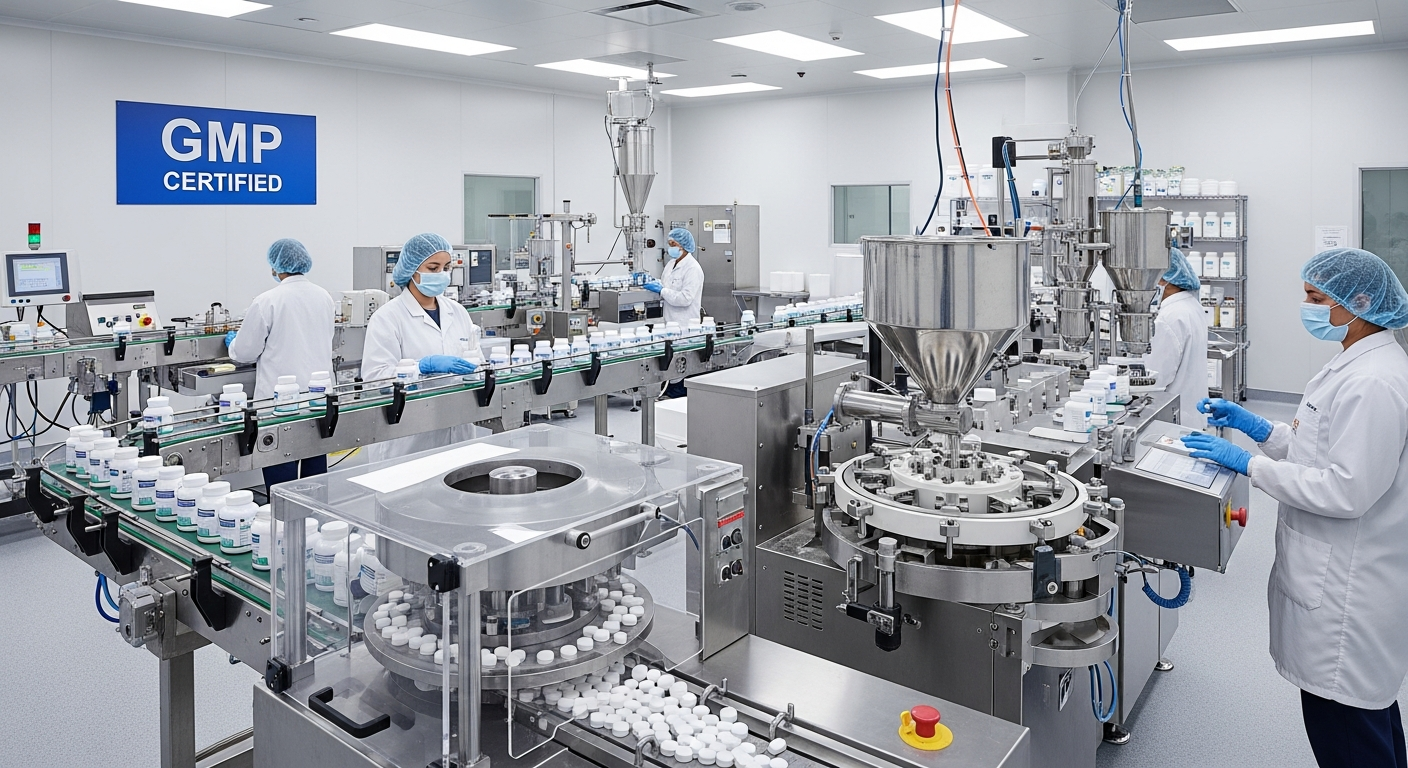
Dietary supplement contract manufacturing involves the production of vitamins, minerals, herbal, and other supplement products according to a brand's own formulation or the manufacturer's standard formulations. The manufacturer provides support in formulation development, raw material procurement, production, quality control, packaging, and even licensing processes.
Supplement Forms and Production Processes
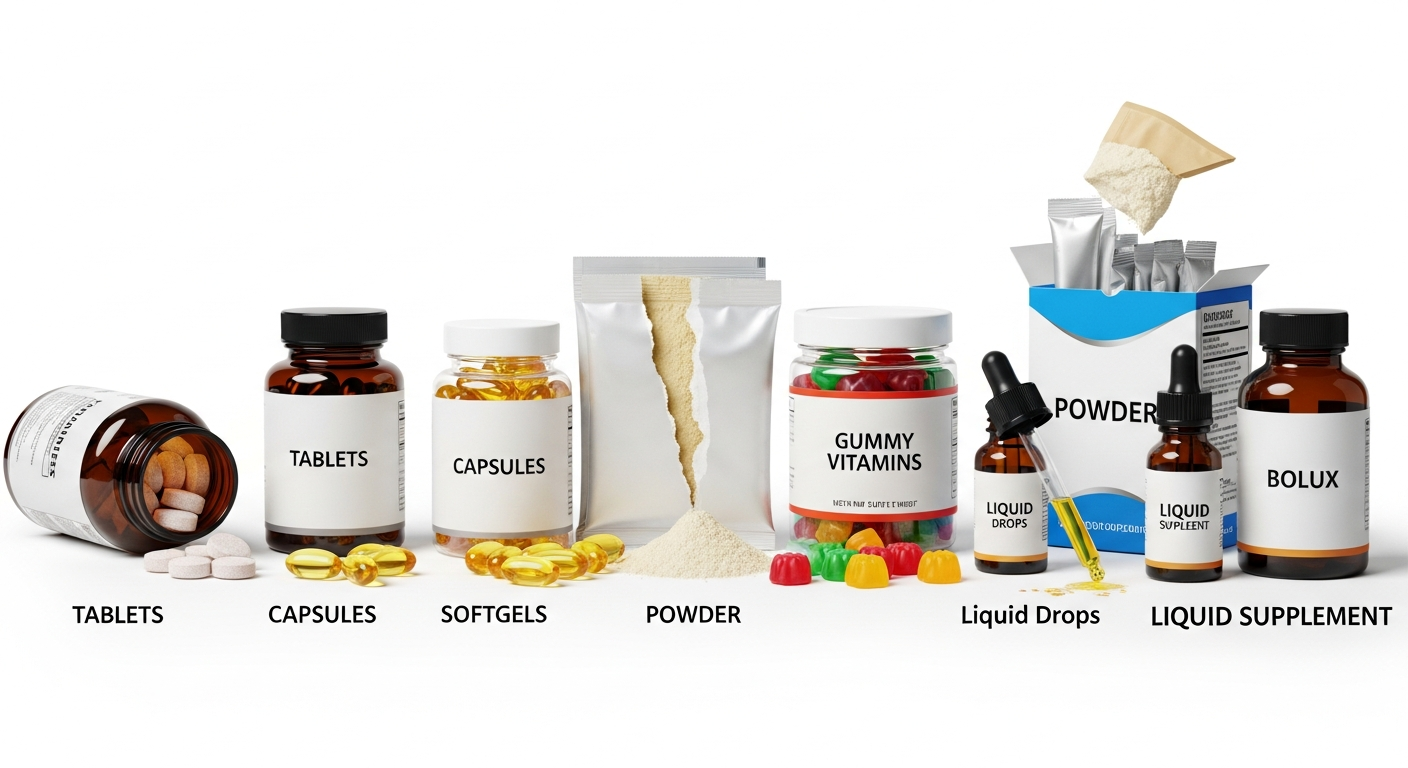
1. Tablet Production
The most common dietary supplement form. Active ingredients are mixed with fillers and binders and shaped using tablet presses. Film coating provides ease of swallowing and stability.
2. Capsule Production
Produced in hard gelatin capsule (HPMC or gelatin) or soft gelatin capsule (softgel) forms. Ideal for liquid, oil-based, and powder formulations.
3. Powder and Granule Production
Products like protein powders, collagen, and super food blends are produced in this form. Presented in sachet or jar packaging.
4. Gummy Production
The most popular form in recent years, gummy vitamins are preferred especially for vitamin, mineral, and herbal supplements. For detailed information about the gummy vitamin market and manufacturing opportunities, see our Vitamin Gummy Market and Manufacturing Opportunities article.
5. Liquid and Drop Production
Supplements like iron, vitamin D, and probiotics can be produced in liquid or drop form. Preferred especially for baby and children's products.
Finding Dietary Supplement Manufacturers in Turkey
The most effective platform for finding dietary supplement contract manufacturers in Turkey is TR2B. Through TR2B, you can reach specialized supplement manufacturers, check their GMP certification status, compare production capacities, and contact them directly.
Manufacturer Selection Criteria
- GMP Certificate: Good Manufacturing Practices certification is mandatory
- Production Forms: Capacity for the form you need (tablet, capsule, gummy, etc.)
- R&D Capacity: Formulation development and stability testing capabilities
- Minimum Order: MOQ (Minimum Order Quantity) and batch sizes
- Licensing Support: Assistance with regulatory notification and licensing processes
- Export Experience: Certifications and experience for international markets
Tips for a Successful Dietary Supplement Brand
- Identify a niche target audience and product segment
- Develop formulations based on scientific research
- Choose a reliable, GMP-certified contract manufacturer
- Create attention-grabbing and trust-building packaging design
- Implement digital marketing and content marketing strategies
- Focus on building customer reviews and social proof
For food sector manufacturing processes and regulations, see our Food Contract Manufacturing: Complete Guide.
Dietary Supplement Contract Manufacturing Guide: Supplier Decision Framework
The commercial value of Dietary Supplement Contract Manufacturing Guide is not the definition itself. It is the way brand owners, quality teams and sourcing managers can use What is Dietary Supplement Contract Manufacturing? to screen suppliers before time is spent on samples or negotiation.
If accepting a quotation before the regulatory, stability and test-report responsibilities are written down, the buyer is comparing impressions instead of capability. Make the missing proof visible and pause the project until the gap is closed.
Supplier Signals Worth Checking
| Evidence | Signal | Decision Use |
|---|---|---|
| ingredient and specification file | sample approval time | Use this line to turn dietary, supplement, manufacturing, guide from a keyword into a procurement control. |
| label or claim review | complaint and nonconformance response | Use complaint and nonconformance response to decide whether Dietary Supplement Contract Manufacturing Guide is ready for supplier comparison. |
| shelf-life or stability rationale | test-report turnaround | Connect shelf-life or stability rationale to test-report turnaround before price becomes the main filter. |
| batch and traceability record | certificate scope | Ask who owns batch and traceability record and how certificate scope will be checked. |
From Reading to Supplier Action
The page earns its place when it turns broad research into one visible sourcing action.
- Dietary Supplement Contract Manufacturing Guide: Ask for the exact product form and target market.
- Dietary Supplement Contract Manufacturing Guide: Request certificate scope and recent test evidence.
- Dietary Supplement Contract Manufacturing Guide: Define sample, pilot and release criteria before price comparison.
Dietary Supplement Contract Manufacturing Guide: Operating File
Dietary Supplement Contract Manufacturing Guide should become an operating file, not a loose reading note. For Dietary Supplement Manufacturing, the file should keep scope, quality evidence, commercial limits and follow-up ownership together.
Anchor the file around 1. Tablet Production. That keeps the team from comparing suppliers on price alone and makes later changes easier to audit.
| Control | How to use it |
|---|---|
| Scope | Define what Dietary Supplement Contract Manufacturing Guide includes and excludes before supplier contact. |
| Proof | Ask which document, sample or record supports 1. Tablet Production. |
| Timing | Separate first reply, sample review, pilot order and volume approval for Dietary Supplement Contract Manufacturing Guide. |
| Owner | Assign one person to collect missing data and update the Dietary Supplement Contract Manufacturing Guide file. |
Dietary Supplement Contract Manufacturing Guide: final check
- Write the buyer or supplier objective for Dietary Supplement Contract Manufacturing Guide in one paragraph.
- List the documents that would make 1. Tablet Production verifiable.
- Compare price only after scope, evidence and timing are written.
- Keep the next action concrete: request data, approve sample, run pilot or stop.
Related buyer paths across the network
Guides That Complete the Supplement Decision
Related checks for Dietary Supplement Contract Manufacturing Guide: review these pages before supplier approval or production release.
- Vitamin Gummy Market and Manufacturing Opportunities
- Dietary Supplement Regulations and Licensing
- Probiotic and Prebiotic Contract Manufacturing Guide
- Quality Management in Contract Manufacturing
- How to Prepare a Manufacturing Contract
- What is Contract Manufacturing? Complete Guide
- Contract Manufacturing: Advantages and Disadvantages
- Contract Manufacturing Processes: Step by Step Guide
Sources and Further Reading
Source check for Dietary Supplement Contract Manufacturing Guide: official standards, regulator pages and sector references are listed below. Validate final legal, medical, food or export decisions against the current primary text.