Contract manufacturing is a business arrangement where a company hires another manufacturer to produce products under its own brand. This model is ideal for businesses that lack production capacity or seek cost advantages.
Definition of Contract Manufacturing
Contract manufacturing occurs when a company outsources the production of its products to a third-party manufacturer. The manufacturer produces goods according to the specifications provided by the hiring company.

Types of Contract Manufacturing
1. Full Contract Manufacturing
The manufacturer handles everything from raw material procurement to final product delivery. The client only provides design specifications.
2. Partial Contract Manufacturing
The client provides raw materials while the manufacturer handles the production processes.
3. Labor-Only Manufacturing
Only specific labor operations are outsourced to the contract manufacturer.
Advantages of Contract Manufacturing
- Lower investment costs
- Faster time-to-market
- Flexible production capacity
- Access to specialized expertise and equipment
- Focus on core competencies
Disadvantages of Contract Manufacturing
- Quality control challenges
- Limited process control
- Supplier dependency risk
- Intellectual property concerns
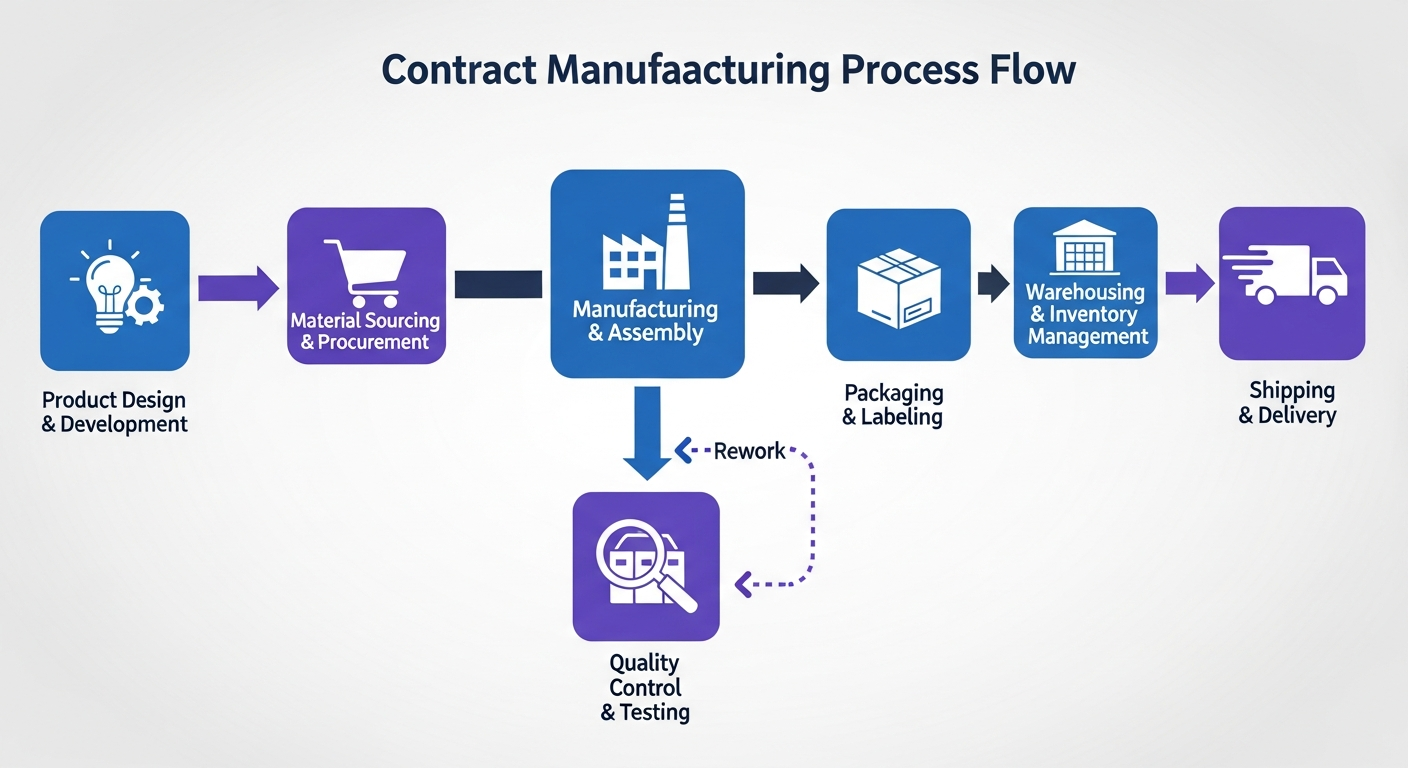
Learn more about the advantages and disadvantages of contract manufacturing, or explore the step-by-step manufacturing processes.
What is Contract Manufacturing? Complete Guide: Supplier Decision Framework
A serious review of What is Contract Manufacturing? Complete Guide starts with one question: can the reader prove the topic can be turned into a documented supplier decision instead of a loose research note? The answer should be visible in the supplier file, not only in a sales conversation.
The practical failure mode is reading definitions without translating them into evidence, owner, deadline and next action. Before approving a next step, write the evidence that would make the decision defensible.
Supplier Signals Worth Checking
| Evidence | Signal | Decision Use |
|---|---|---|
| written scope | decision speed | If decision speed is weak, keep What is Contract Manufacturing? Complete Guide in clarification rather than approval. |
| supplier evidence | risk closure | Make supplier evidence visible in the file so the next buyer can audit the decision. |
| quality or compliance record | supplier fit | Treat supplier fit as the signal that separates a claim from usable proof. |
| commercial next step | document completeness | Score commercial next step against the same rule across every supplier reply. |
From Reading to Supplier Action
The best outcome is not more reading. It is a narrower, better documented next conversation.
- For Contract Manufacturing Guide, make this explicit: Write the requirement in buyer language.
- For Contract Manufacturing Guide, make this explicit: Ask for evidence before comparing price.
- For Contract Manufacturing Guide, make this explicit: Decide the next gate: sample, pilot, quote or stop.
What is Contract Manufacturing? Complete Guide: Supplier Decision Note
For What is Contract Manufacturing? Complete Guide, use the article as a supplier decision note inside Contract Manufacturing Guide. The practical question is not whether the topic is interesting; it is whether the buyer can define scope, request proof and decide the next gate without adding guesswork.
Start from 2. Partial Contract Manufacturing. Then turn the idea into one written brief that names the product or service scope, the acceptance rule, the document owner and the point where the project should pause.
| Control | How to use it |
|---|---|
| Scope | Define what What is Contract Manufacturing? Complete Guide includes and excludes before supplier contact. |
| Proof | Ask which document, sample or record supports 2. Partial Contract Manufacturing. |
| Timing | Separate first reply, sample review, pilot order and volume approval for What is Contract Manufacturing? Complete Guide. |
| Owner | Assign one person to collect missing data and update the What is Contract Manufacturing? Complete Guide file. |
What is Contract Manufacturing? Complete Guide: final check
- Write the buyer or supplier objective for What is Contract Manufacturing? Complete Guide in one paragraph.
- List the documents that would make 2. Partial Contract Manufacturing verifiable.
- Compare price only after scope, evidence and timing are written.
- Keep the next action concrete: request data, approve sample, run pilot or stop.
Editorial quality checklist for Contract Manufacturing Guide
What is Contract Manufacturing? Complete Guide EN guide should be used as a working decision file, not only as a reading page. The practical check is whether a buyer can leave the article with a clear scope, required evidence, supplier questions, risk owner and next action for Contract Manufacturing Guide.
For stronger SEO and buyer usefulness, this page now connects the topic to proof, implementation and related sourcing paths. That reduces thin-content risk and helps the reader move from general research to a verifiable supplier or operating decision.
- Define the decision: write product or service scope, target market, expected volume, approval owner and the date of the next review.
- Ask for current evidence: request documents that match this exact product, service, batch, process or customer scenario.
- Compare complete answers: score response quality, missing data, correction speed and commercial assumptions before comparing price.
- Keep the first order controlled: connect sample approval, release criteria, logistics, payment terms and corrective action in one note.
| Review area | Quality question |
|---|---|
| Scope | Product, market, volume, owner and release rule are written before supplier comparison. |
| Evidence | Specification, sample, quality record, certificate, label or service proof is checked for date and relevance. |
| Decision | The buyer records what can be approved now, what is blocked and who owns the next correction. |
FAQ for this article
What should be checked first for Contract Manufacturing Guide?
Start with the decision file: scope, evidence, acceptance criteria, delivery assumptions and the person who can approve or stop the next step.
How does this article support supplier or partner selection?
It turns the topic into a checklist of records, questions and comparison rules, so the reader can separate a strong answer from a generic sales reply.
When should the reader move to a related guide?
Move to a related guide when the next risk is outside the current page, such as supplier discovery, contract manufacturing, food safety, logistics or company verification.
Useful cross-site next reads
Read Before Moving Forward
Related checks for What is Contract Manufacturing? Complete Guide: review these pages before supplier approval or production release.
- Contract Manufacturing: Advantages and Disadvantages
- Contract Manufacturing Processes: Step by Step Guide
- Cost Calculation in Contract Manufacturing
- Quality Management in Contract Manufacturing
- How to Prepare a Manufacturing Contract
- Choosing the Right Contract Manufacturing Partner
- What Is MES? Manufacturing Execution Systems for Contract Manufacturing
- OEE Explained: How to Calculate Manufacturing Performance Without Fooling Yourself
Sources and Further Reading
Source check for What is Contract Manufacturing? Complete Guide: official standards, regulator pages and sector references are listed below. Validate final legal, medical, food or export decisions against the current primary text.