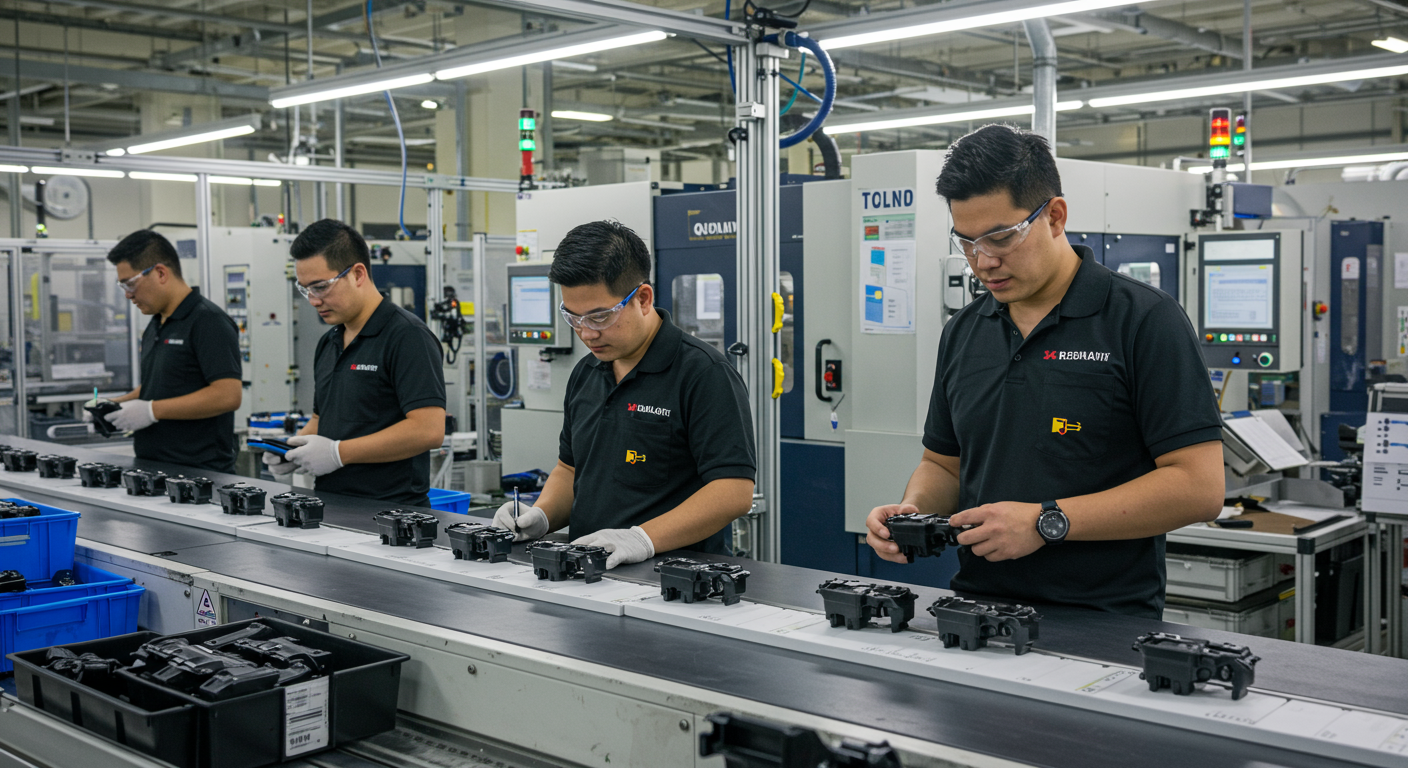
A Manufacturing Execution System is not simply factory software. In contract manufacturing, MES is the operating layer that connects the agreed specification, the production order, the shop-floor event and the quality record.
The NIST and ISA-95 material is useful because it puts MES in the middle of the business-to-shop-floor gap: ERP tells the plant what should happen, but MES proves what actually happened, when it happened and under which controlled conditions.

Why MES matters before the first batch
The strongest MES decision starts with process discipline rather than a software shopping list. If routings, material lots, quality checks and approvals are unclear on paper, digitizing them only makes the confusion faster.
For buyers and suppliers, this changes the conversation. Instead of asking only whether a factory has capacity, the better question is whether the factory can capture orders, batches, labor, downtime, nonconformance and release records in a way that both sides can trust.
Signals of MES maturity
- Check whether production orders are tied to a released specification version.
- Ask how batch, lot and operator records are captured without manual retyping.
- Look for exception handling: deviation, rework, scrap and hold decisions matter more than the perfect run.
- Require a clear data owner for master data, formulas, routings and quality plans.
- Use MES reporting to improve changeovers, downtime learning and delivery reliability, not only to create dashboards.
What the sources change in the decision
The open references point to one practical lesson: MES should be evaluated as a manufacturing operations management capability. ISA-95 helps separate business planning from shop-floor execution; NIST reinforces the need for interoperable, model-based operations. That means a buyer should not be impressed by screens alone. The evidence is whether the system prevents uncontrolled production.
Implementation path for a smaller manufacturer
- Map one high-risk product family before buying modules.
- Define the minimum electronic batch record needed for that family.
- Connect quality holds and release criteria to the production order.
- Measure downtime reasons with a fixed taxonomy for at least eight weeks.
- Use pilot evidence in supplier profiles and RFQ answers.
How to turn MES into buyer confidence
MES is worth writing about for FasonZon because it attracts serious manufacturers: the companies that want fewer surprises, cleaner audits and more credible buyer conversations.
After this preparation, state your scope, evidence, sample process, MOQ and quality records clearly in the supplier profile. Use TR2B contract manufacturing category for the relevant category, the TR2B overview guide for profile setup and TR2B service pages when service listing is the right next step.
What Is MES? Manufacturing Execution Systems for Contract Manufacturing: Supplier Decision Framework
Treat What Is MES? Manufacturing Execution Systems for Contract Manufacturing as a buyer-side decision aid. The article becomes stronger when Signals of MES maturity and Signals of MES maturity are converted into questions a supplier can answer with documents.
A common mistake is quoting assembly cost without knowing test depth, component risk and acceptance criteria. Keep the discussion practical by asking what would change the decision: a sample, a certificate scope, a pilot result or a written exception.
Evidence to Put in the File
| Evidence | Signal | Decision Use |
|---|---|---|
| BOM and revision control | component lead-time risk | If component lead-time risk is weak, keep What Is MES? Manufacturing Execution Systems for Contract Manufacturing in clarification rather than approval. |
| IPC or workmanship criteria | test coverage percentage | Ask who owns IPC or workmanship criteria and how test coverage percentage will be checked. |
| ESD control evidence | first-pass yield | Connect ESD control evidence to first-pass yield before price becomes the main filter. |
| functional or in-circuit test coverage | defect Pareto | Use defect Pareto to decide whether What Is MES? Manufacturing Execution Systems for Contract Manufacturing is ready for supplier comparison. |
How to Use This in Contract Manufacturing Guide
The best outcome is not more reading. It is a narrower, better documented next conversation.
- For Contract Manufacturing Guide, make this explicit: Send controlled Gerber, BOM and assembly notes.
- For Contract Manufacturing Guide, make this explicit: Separate prototype assumptions from production assumptions.
- For Contract Manufacturing Guide, make this explicit: Ask for test evidence before approving ramp-up.
Editorial quality checklist for Contract Manufacturing Guide
What Is MES? Manufacturing Execution Systems for EN guide should be used as a working decision file, not only as a reading page. The practical check is whether a buyer can leave the article with a clear scope, required evidence, supplier questions, risk owner and next action for Contract Manufacturing Guide.
For stronger SEO and buyer usefulness, this page now connects the topic to proof, implementation and related sourcing paths. That reduces thin-content risk and helps the reader move from general research to a verifiable supplier or operating decision.
- Define the decision: write product or service scope, target market, expected volume, approval owner and the date of the next review.
- Ask for current evidence: request documents that match this exact product, service, batch, process or customer scenario.
- Compare complete answers: score response quality, missing data, correction speed and commercial assumptions before comparing price.
- Keep the first order controlled: connect sample approval, release criteria, logistics, payment terms and corrective action in one note.
| Review area | Quality question |
|---|---|
| Scope | Product, market, volume, owner and release rule are written before supplier comparison. |
| Evidence | Specification, sample, quality record, certificate, label or service proof is checked for date and relevance. |
| Decision | The buyer records what can be approved now, what is blocked and who owns the next correction. |
FAQ for this article
What should be checked first for Contract Manufacturing Guide?
Start with the decision file: scope, evidence, acceptance criteria, delivery assumptions and the person who can approve or stop the next step.
How does this article support supplier or partner selection?
It turns the topic into a checklist of records, questions and comparison rules, so the reader can separate a strong answer from a generic sales reply.
When should the reader move to a related guide?
Move to a related guide when the next risk is outside the current page, such as supplier discovery, contract manufacturing, food safety, logistics or company verification.
Useful cross-site next reads
Read Before Moving Forward
Related checks for What Is MES? Manufacturing Execution Systems for Contract Manufacturing: review these pages before supplier approval or production release.
- What is Contract Manufacturing? Complete Guide
- Contract Manufacturing: Advantages and Disadvantages
- Contract Manufacturing Processes: Step by Step Guide
- Quality Management in Contract Manufacturing
- Cost Calculation in Contract Manufacturing
- How to Prepare a Manufacturing Contract
- Choosing the Right Contract Manufacturing Partner
- OEE Explained: How to Calculate Manufacturing Performance Without Fooling Yourself
Sources and Further Reading
Source check for What Is MES? Manufacturing Execution Systems for Contract Manufacturing: official standards, regulator pages and sector references are listed below. Validate final legal, medical, food or export decisions against the current primary text.